
What You Should Know About HiAnime’s Death
The top pirate site in the US just shut down. It only had anime.


HiAnime, the biggest bootleg anime streaming platform on the English-speaking internet, is reportedly dead. Piracy has a long and unique history in the world of anime, and so I thought I’d take this opportunity to give some context to the site, and respond to some of the most common reactions I’ve seen on the topic of HiAnime and anime piracy in general.
1. HiAnime was the biggest bootleg anime platform in the States, accounting for ~15% of all anime piracy with ~4M US monthly users, per White Box analysis. In the last year, US users represented 30% of HiAnime’s traffic, so the worldwide total is closer to 14 million.
I’ve seen many online commentators make comparisons using SimilarWeb data that HiAnime has more web traffic than Crunchyroll. That’s been the case at some points, and it’s no lie that the HiAnime website has similar US traffic to hulu.com and disneyplus.com as well, but that’s a fairly misleading way to understand the situation. Web traffic represents less than 20% of viewership for Hulu and Disney+ (most people watch on apps), so while HiAnime’s size is anything but small, this is an unfair comparison.
Let’s not forget that there are hundreds of English-language anime-dedicated bootleg streaming sites with meaningful traffic. Anime is disproportionately pirated compared to other forms of entertainment — to this point, using data from SimilarWeb, in February 2026, HiAnime received more US visitors than any other non-pornographic pirate site, anime or otherwise. But thanks to the growth of viewership on platforms like Crunchyroll and Netflix, the share of legal anime viewing is trending in a positive direction. (Meanwhile, non-anime piracy is on the rise due to increased income inequality, and more streaming services with higher prices, but that’s an analysis for another day.)
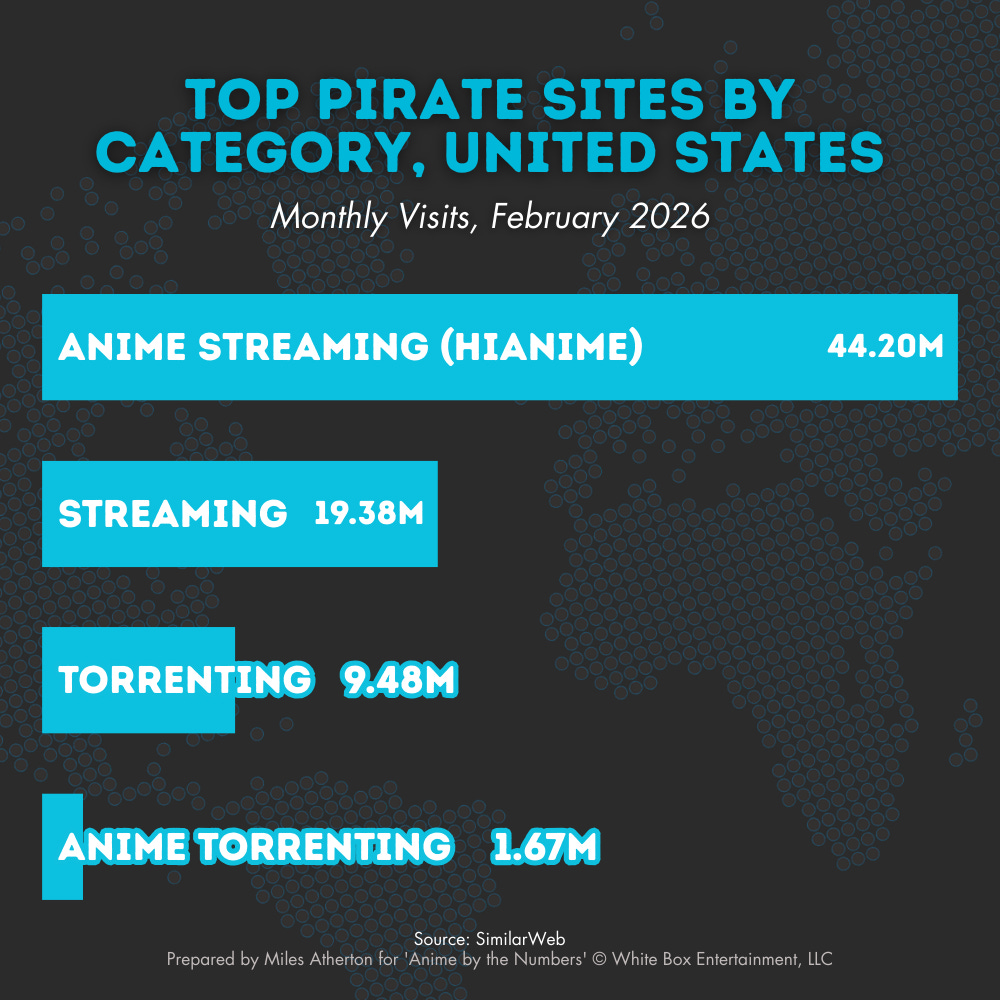
2. Unlike the fansubs sites of yesteryear, HiAnime (and many other popular anime streaming sites) was a for-profit outlet. The pirated film/TV sites of the past 5-10 years exist to get ad revenue, and not for media preservation. HiAnime made the people running it a lot of money.
3. Many fans say sites like HiAnime are integral to accessing unlicensed/unavailable anime outside Japan, but unlicensed series represented less than 1% of US viewership, per White Box. The most popular titles on HiAnime were mostly the most broadly available series.
This doesn’t account for non-US/Canada viewers using piracy to access popular series not available in their regions, but it does represent a shift in why and how people pirate anime. The hobby of anime used to include seeking it out, often through piracy, but now it is fueled by algorithmic discovery (on streaming platforms and social media), so most of what is watched is what is promoted, or what is already popular.
4. That said, a slight majority of people who used HiAnime used it in tandem with legitimate anime streaming. This means many people used it to “fill gaps” if they didn’t have a certain streaming service, or because they didn’t know where to watch a certain series.
5. Most of the subtitles (90%+) were not “fansubs,” but rips of the official subtitles. Much like the big manga/manhwa piracy sites, even the fansubs were ripped from the fansub groups and monetized, which isn’t really any better.
6. There will always be plenty of other anime pirating sites, but whenever the top pirate site goes down, a decent chunk of its users switch to legal services. Since most anime revenue comes from overseas streaming these days, every legal view outside Japan counts even more towards your favorite series continuing.
Normally everything past this point would be for paid subscribers only, but this week, it’s free for everyone. If you’d like to support more nuanced analysis of the anime industry, here’s a special deal to join us. Thanks!
7. There are a lot of reasons why people have to pirate media, and those who do are not morally bad people. However, using streaming sites just funnels ad revenue to third parties taking advantage of anime fans, and does nothing to really help the industry. While it’s a little harder than it used to be, if you have to pirate, torrenting is still the most ethical bet.
8. Anime isn’t just an ad for the source material, so going to buy the light novel or manga to “make up” for pirating the anime isn’t as helpful as you think. (That being said, please go buy the manga and the light novels, it helps in other ways!) The anime industry is 2-3 times the size of the manga industry. An anime adaptation boosting manga/light novel sales is definitely one reason for a publisher’s interest, but the publisher is just one member of an anime’s production committee, which contains companies with various financial interests. The majority of committees aren’t led by the publisher of the source material. “Advertising” the source material is not nearly as important as folks make it out to be, and it’s certainly not “the” reason why an anime is made.
9. Not wanting to pay a “middleman”, like Crunchyroll for anime, is more complicated than you think. The concept of a “middleman” in anime is slowly becoming obsolete, as streaming services also produce a lot of anime by sitting on many production committees.
This is also true of official manga apps/sites/publishers, who are often owned or partially owned by the publisher themselves, and not always a “middleman” company.
10. Buying official merchandise to “make up” for pirating an anime isn’t as helpful as you think, either. Most people who say this don’t actually do it for every title they watch (and to be fair, that can be difficult, because not every title gets widely distributed licensed merchandise). But this means it’s a “rich get richer” situation, where any title that’s not someone’s top favorite gets $0 from them, whereas watching on legal outlets at least provides something back to the producers of the anime (the committee). People who use bootleg platforms are also understandably more likely to buy bootleg/unofficial goods, which doesn’t support the anime either.
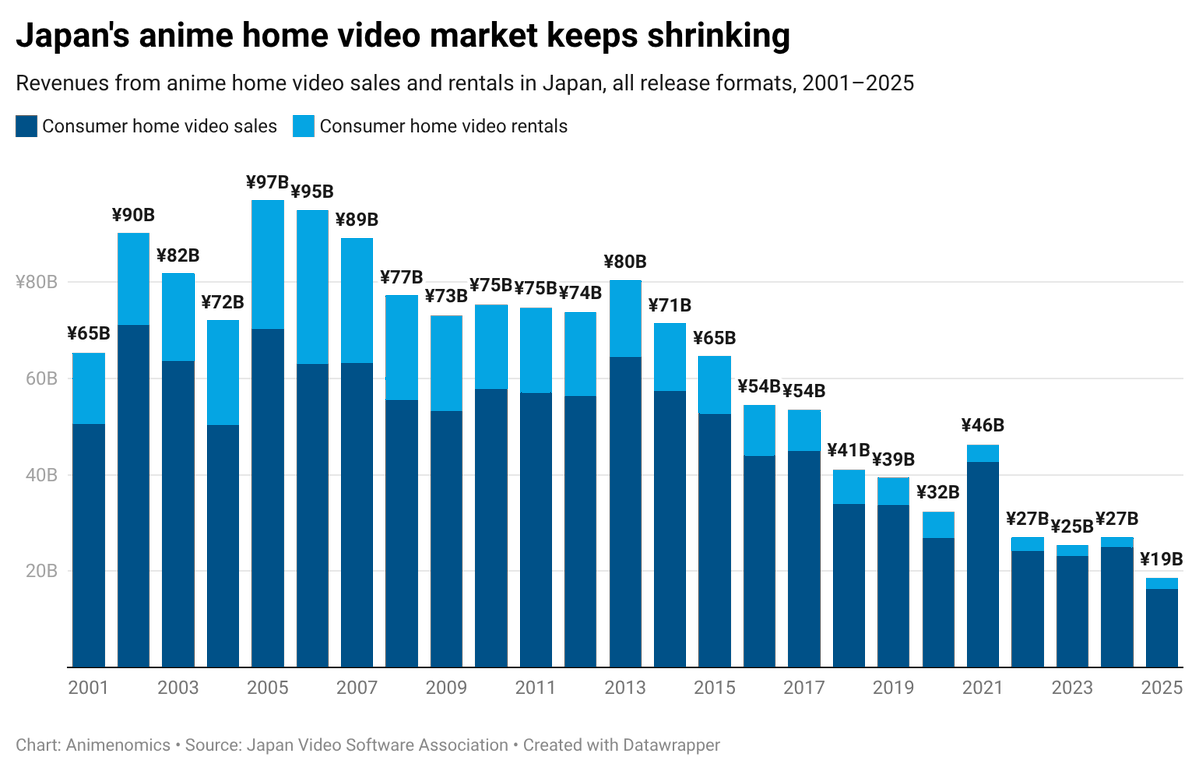
11. Some people import the Japanese Blu-ray release to “make up” for pirating a title, but they are the outliers of all outliers. Japanese home video sales have fallen off a cliff during the exact period that the overseas anime audience rapidly. (You can read more about this in Animenomics’ report on the changing JP home video market).
Note: I’m centering a lot of this in the US to make more like-to-like comparisons, and because internationalizing this brings in a great deal of additional complexity and nuance.
What are your opinions on anime piracy, and streaming piracy as a whole? Let us know in the comments, and make sure to share the newsletter with a friend.
I wish there was a way to purchase and download episodes/seasons for offline storage, like you can do with digital downloads of music (from Bandcamp, for example)
All great points.
The reason I prefer piracy over legal anime streaming in my country (i.e, Crunchyroll) is the anti-consumer practices by them - removing the comments section, typesetting downgrade, AI translations, unstable software (video player), misuse of user data, and many more. All while aggressively increasing their subscription prices.
While I fully support the concept of legal anime streaming, I do not support the companies that currently dominate that space. And piracy is my way of voting with my feet.
I do also want to add that I spend a ton of money on buying physical manga volumes and sometimes merch as well, it's not that I can't afford to pay for streaming or am averse to spending money on it. But companies need to meet their customers in the middle here, and need to realise that its their constant enshittification of their services is why many people don't want to pay them.